
Romania catches up to Poland in GDP per capita: myth or economic reality?
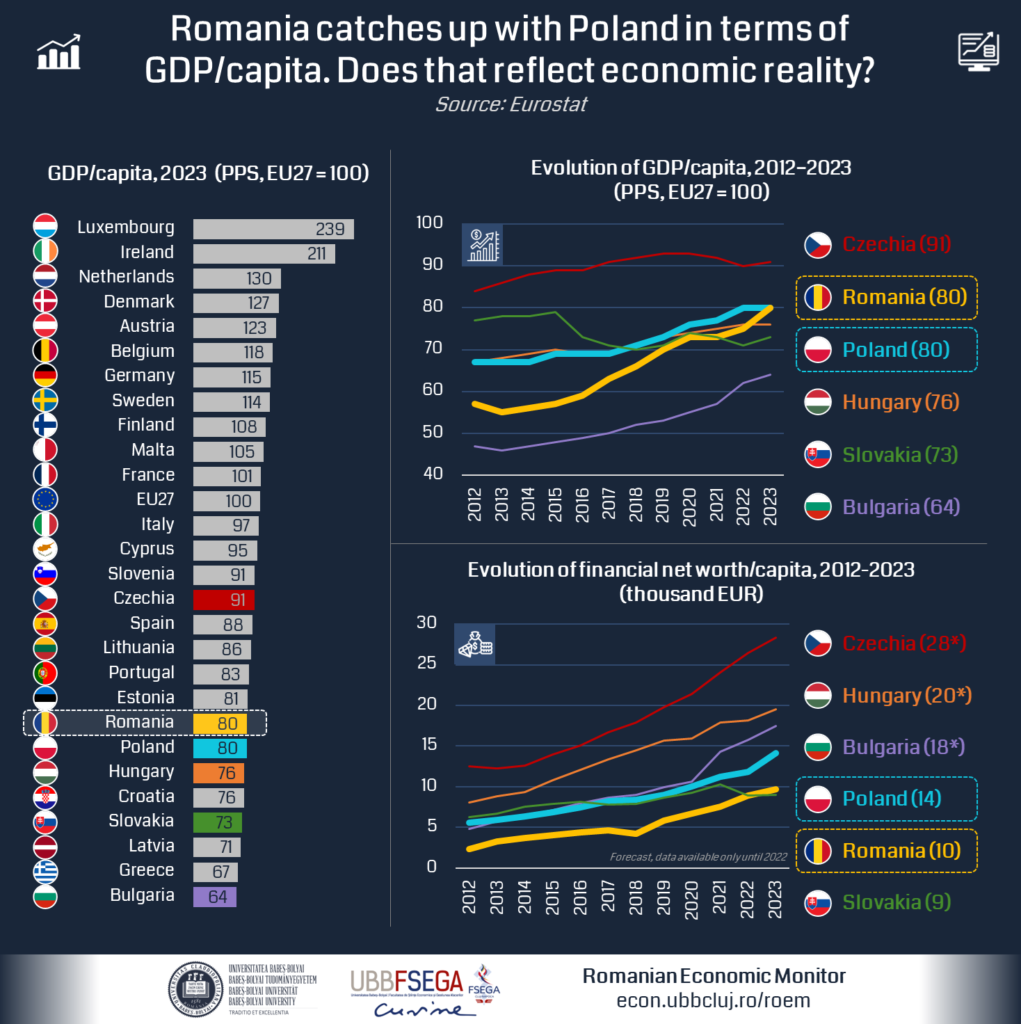
Over a year ago, Eurostat data revealed that Romania’s GDP per capita, measured in purchasing power parity (PPP), surpassed Portugal and Hungary. The latest June data shows Romania has now caught up with Poland, ranking above six EU countries: Hungary, Croatia, Slovakia, Latvia, Greece, and Bulgaria. Romania, like Poland, reaches 80% of the EU average GDP per capita, a significant rise from 55% a decade ago.
Despite these figures, public perception and some analysts suggest these estimates may be exaggerated, indicating that Romania’s development is not yet comparable to Poland’s. The reasons for this perception gap can be categorized into two main issues: the limitations of GDP per capita measured in PPP, and the insufficiency of using a single indicator to gauge a country’s economic development accurately.
Limitations of GDP Per Capita (PPP)
- Aggregated Indicator: GDP per capita is an aggregated measure that does not account for income disparities across different regions or social groups within a country.
- Well-being Measurement: GDP is commonly used to measure economic development but does not accurately reflect individual well-being. Differences in income distribution can lead to varying perceptions of economic prosperity.
- Measurement Complexity: Measuring GDP, especially in PPP, involves uncertainties and potential revisions, making long-term trends more reliable than current figures.
- Purchasing Power Parity: PPP aims to equalize the purchasing power of different currencies but is subject to uncertainties and variations in consumer basket compositions.
Economic Reality vs. Perception
Despite equal GDP per capita in PPP terms with Poland, the economic reality in Romania is perceived as different due to various other indicators. For instance, Romania ranks near the bottom in the region for net financial assets per capita, highlighting significant financial disparities. Other metrics, such as human development indicators or the state of education and healthcare systems, further illustrate areas needing improvement.
Final thoughts
While GDP per capita shows Romania catching up to Poland, the economic reality is more complex. Significant progress has been made, as seen in the impressive GDP growth rate over the past decade. However, sustainable development and real convergence with Poland will require addressing major economic challenges such as budget deficits, current account deficits, and internal inequalities.