
The role of productivity in sustainable wage growth
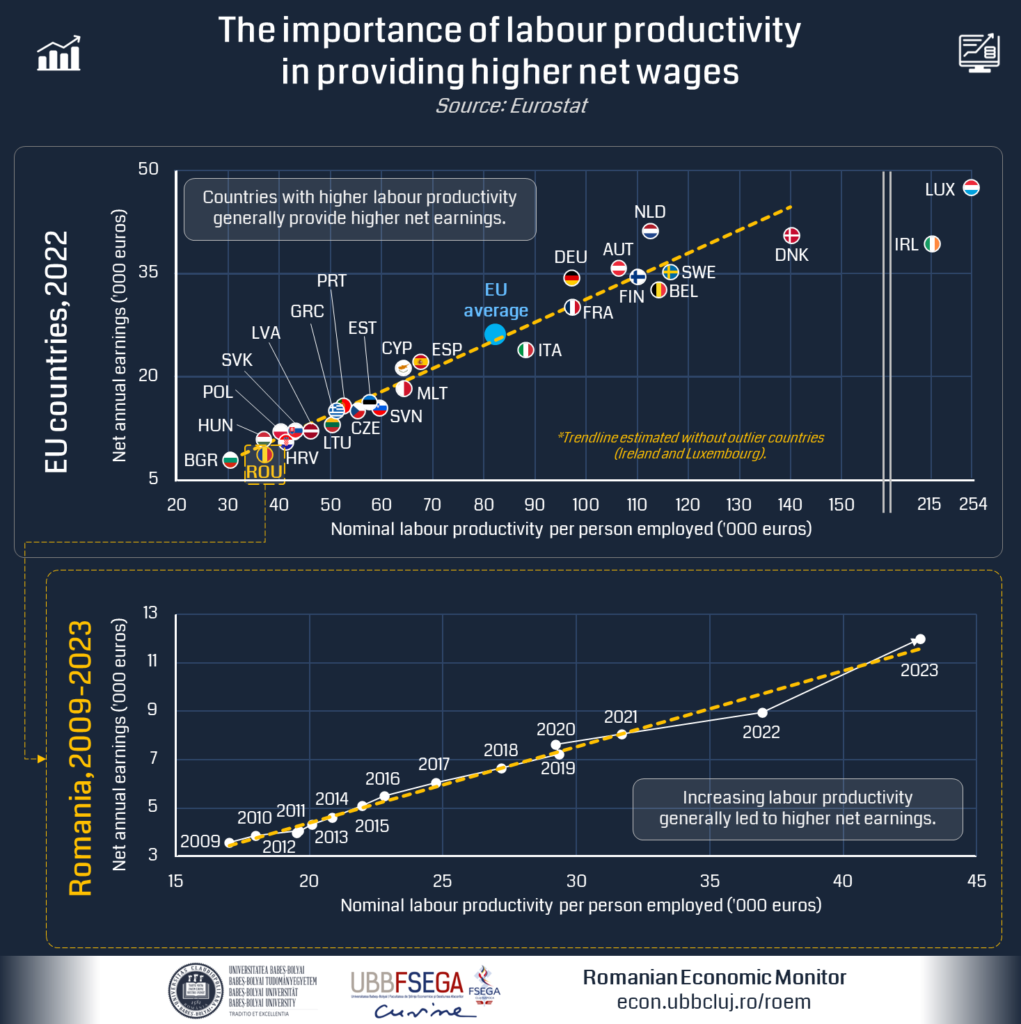
The European Commission’s March 2024 report highlights that real wages in Romania are rising faster than labor productivity, measured by nominal added value per capita. This discrepancy can hinder efforts to reduce inflation and impact economic competitiveness. The RoEM team analyzed this phenomenon both at the European and Romanian levels.
Data and economic theory suggest that sustainable long-term real wage growth is possible only if labor productivity increases simultaneously. In Europe, countries with higher per capita added value can afford to pay higher wages. However, this relationship isn’t always linear. In 2022, Romania’s average net wages were below the trend line, indicating that incomes were lower than expected given productivity gains. Possible explanations include the prevalence of the gray economy and higher dividends to owners and investors rather than wages to workers.
Between 2015 and 2019, wages in Romania were slightly above the trend line, supported by fiscal policies. The pandemic year of 2020 saw wages remain above trend despite stagnant productivity. In 2021 and 2022, a normalization occurred, followed by a decline due to significant inflation, which reduced purchasing power. In 2023, wages approached the trend line again, growing faster than productivity. Forecasts for 2024 predict a 12.5% increase in net wages, likely outpacing productivity growth.
This wage growth might not be sustainable in the long term. For a robust wage growth foundation, Romania needs to significantly boost productivity, potentially through the faster and more efficient adoption of new digital technologies by domestic companies.