
Romania’s economic growth: regional disparities and challenges
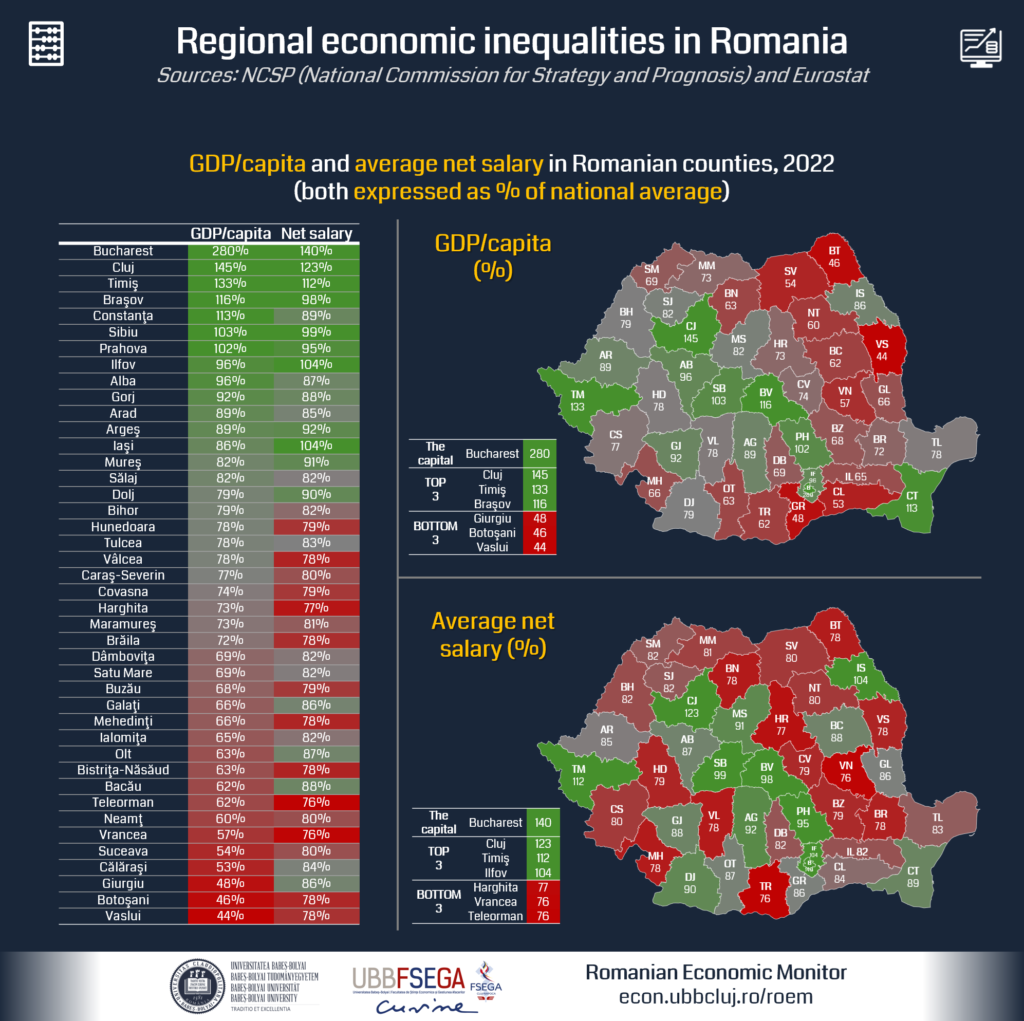
In recent years, Romania’s economic performance, particularly in terms of GDP per capita, has shown significant progress. Ten years ago, Romania’s GDP per capita was 55% of the EU average. Today, it has reached 80%, surpassing Hungary and Slovakia, and matching Poland. However, regional economic inequalities persist. While leading regions like Brașov, Cluj, and Timiș have GDP per capita levels 116-145% of the national average, underperforming counties such as Botoșani and Vaslui only reach 44-48%. Bucharest far exceeds all regions, at 280%.
These regional economic disparities also influence average wages, generally higher in regions with a stronger GDP per capita. However, some counties like Vaslui and Botoșani show a divergence, with lower GDP per capita but relatively higher wages, due to factors like minimum wage laws, unemployment differences, and public sector jobs.
To reduce these disparities, economic productivity must improve. This can be achieved through domestic and foreign investments, entrepreneurship, infrastructure and technology development, as well as investments in education and innovation.