
Romania’s budget deficit in 2025: between stabilization and stagnation
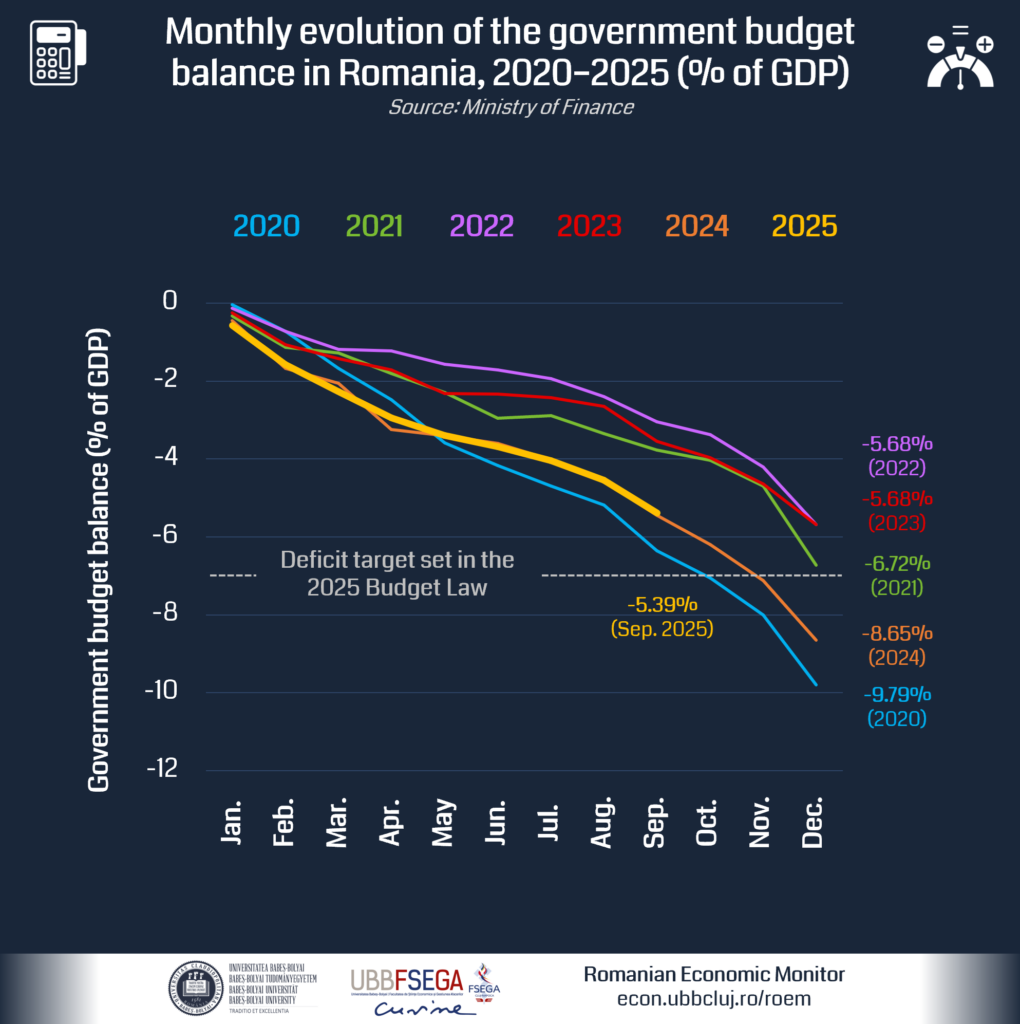
The monthly evolution chart of the government budget balance using the cash method shows that in 2025, the deficit gradually deepened, with the current year’s graph falling faster than in 2021–2023 and reaching the same level as in 2024. As the deficit target set by the 2025 state budget law was 7% of GDP—a level that also formed the basis for subsequent discussions with the European Commission on reframing—the dynamics of the first nine months of the year raise questions. If this trend continues in the last quarter, then the deficit in 2025 will remain roughly the same as in 2024. Although the measures adopted should have their strongest impact in the fourth quarter, achieving the target set by the European Commission remains a serious challenge.
However, the cash-based deficit calculation has important limitations: it only captures the actual cash inflows and outflows of the state, is strongly influenced by seasonality, and can be temporarily altered by accelerating or postponing certain expenditures. For international comparisons and for monitoring the excessive deficit procedure, the benchmark is the deficit calculated according to ESA methodology. According to this method, Romania ended 2024 with a deficit of 9.3% of GDP—the highest in the European Union—and the new target for 2025 is to reduce it to 8.4% of GDP, a very ambitious but not impossible goal.
A surprisingly strong spring and July
Romania’s economy performed strongly in the first half of the year: GDP grew by 1.2% in the second quarter, one of the highest rates in the EU. In July, almost all sectors—industry, construction, services—performed above expectations. The increase was largely due to the “front-loading” effect: companies and the population brought forward purchases and invoicing ahead of the entry into force of the tax increase package on August 1.
These measures, which raised the standard VAT rate to 21% and unified reduced rates at 11%, were perceived as inevitable in order to support fiscal consolidation. However, they also created a wave of activity concentrated in a short period of time, a natural response by businesses and the population to the announced tax changes. The intensity of this wave exceeded expectations, and a significant part of the effect dissipated rapidly after deployment.
August: sudden brake
After July, the economy entered a period of sharp correction. In August, the annual inflation rate rose to 9.9%, from 7.8% in July, amid price increases for non-food goods (10.5%), services (9.8%), and food (8.9%), and in the context of VAT and excise duty increases. The monthly inflation rate of 2.1% explains much of the jump from 7.8% to 9.9% on an annual basis, following another sharp shock in July caused by the removal of energy price caps, given that inflation was still at 5.7% in June.
Purchasing power was rapidly eroded, and the effects were immediately visible in the real economy: retail trade fell by about 4% in August compared to July, industrial production fell by 1.9% compared to the previous month and by 3.1% compared to last year, and construction output corrected by 26.2% after a similar increase in July, indicating a sharp adjustment after a temporary peak. At the same time, unemployment rose to 5.9%, and the average net wage fell to 5,387 lei, 2.4% below the July level; however, this decline is partly seasonal, with RoEM adjustments indicating a real increase of approximately 0.4% for August. Even so, annual wage growth slowed to 4.4%—insufficient to cover inflation—and in September it approached 4.1%, signaling a clear deceleration. The real purchasing power of wages has deteriorated, the consumption momentum from July quickly faded, and trade data, with a decline of about 4% in August, confirms the sharp transition from overheating to adjustment.
Revenues under pressure and the effects of delayed collection
The structure of the public budget shows a strong dependence on two major sources: social contributions, which account for approximately 30% of total revenue, and VAT, which accounts for approximately 20%. However, both engines are losing speed. Wage growth is slowing down, and VAT collection is affected by seasonality and administrative discrepancies: VAT returns and single tax returns must be submitted by the 25th of the following month, which means that the effects of the decline in consumption in August will only be felt in the budget execution in September–October.
Company profitability is also low. Margins have been eroded by high wage costs and low productivity, and corporate income tax is no longer generating increasing contributions. Consequently, in the absence of new sources of revenue for the state budget, the focus will have to shift to expenditure.
Fiscal measures: partial impact in 2025, with an increase in 2026
The tax package that came into effect on August 1 will bring a limited increase in revenue in 2025, for the simple reason that it will only be in effect for four months (September-December). The full impact will only be visible in 2026. In contrast, controlling budgetary expenditure can produce rapid results: reducing bureaucracy, capping public sector jobs, and prioritizing investments financed by European funds are essential to avoid a new misstep. The freeze on hiring and the limitation of vacancies may generate relatively rapid effects, which are already visible in the moderation of the dynamics of the number of employees and net wages, especially in the public sector, a trend that will continue in the coming months. On the other hand, a deep structural reform of the administration—comparable to the fundamental reorganization of a large company—is a lengthy process, especially since the state has approximately 1.3 million employees who would need to be reassigned and retrained.
The Fiscal Council estimates that, without the measures taken in 2025, the deficit would have exceeded 9% of GDP at the end of this year, an almost insignificant decrease from the previous year’s 9.3%. Based on the consistent implementation of these measures, the budget deficit for 2025 is expected to fall to 8.4–8.6%, which will still be—most likely—the highest deficit in the EU.
Cost of financing: a slight easing
The National Bank of Romania maintained its key interest rate at 6.5% at the beginning of October, signaling caution in a context of still high inflation. On the secondary market, the yield on ten-year government bonds gradually fell to 7%, and on October 2, the Ministry of Finance successfully issued €4 billion in three tranches (7, 12, and 20 years) at an average cost of 6.1%.
Even though these signs indicate that access to financing remains open, high interest rates require a firm continuation of fiscal adjustment. Without credible consolidation, reducing borrowing costs will be difficult to achieve.
The external environment is not helping
Economic growth in the eurozone is forecast to be modest, at just 1.2% in 2025, while the German economy—Romania’s main trading partner—remains virtually stagnant. Weak external demand limits export prospects and, implicitly, budget revenues from corporate income tax and VAT.
What’s next in the final months of the year?
With a deficit of 5.39% of GDP (cash method) after three quarters, the authorities need to focus on three major areas:
- Expenditure– strict control of current expenditure and reduction of administrative costs and bureaucracy. Reorganization of local government, resolution of the special pensions issue, and, in general, initiation of system-wide reforms are indispensable.
- Collection– intensifying targeted controls and extending them to increase the efficiency of VAT and contribution collection.
- Real economy– supporting economic activity through targeted investment measures, but especially through the accelerated absorption of European funds.
If these conditions are met, Romania could end 2025 with a deficit between 8.4% and 8.6% of GDP. A better result would require much stricter control of spending, the start of administrative reforms, and higher-than-expected revenue growth in the final months of the year, a scenario that is very difficult, if not impossible, to achieve.
Conclusion
The year 2025 marks the beginning of a necessary adjustment. After a summer of temporary growth in consumption, fueled by anticipation of tax increases, followed by a cold autumn in industry and construction, the economy is showing signs of fatigue. Budget stabilization is only possible through strict discipline on the expenditure side and efficient management of state budget revenues.
Romania has undergone a necessary fiscal change, and the recovery period is just beginning. The real verdict on the correction package will come in 2026, when we will see whether the government, the business community, and society will be able to sustainably support fiscal consolidation. For 2025, an optimistic scenario remains a deficit of approximately 8.4-8.6% of GDP (according to ESA methodology) – a sign that, for now, the adjustment is being made more through restraint than through reform. However, a very difficult first step has already been taken: fiscal correction has begun, and this progress must be continued in a coherent manner, with patience and discipline. Otherwise, the gains made so far could quickly be lost.
Next year, however, it will no longer be possible to avoid the start of real reforms, and the government must move towards effective spending cuts. However, the adjustment cannot be brutal: too abrupt a reduction in public spending risks further reducing activity in the private sector and, implicitly, GDP, all at a time when the economy is already under pressure. Decision-makers seem aware of this risk and are trying to avoid entering a negative spiral of economic recession, social tensions, and additional political costs. Without gradual but real cuts in budgetary expenditure, Romania will remain for a long time among the countries with the highest deficits in the EU, and the combination of a persistent fiscal imbalance and economic slowdown could have extremely serious consequences. Therefore, we are not at the end of the budgetary balancing process, but only at the beginning, and the coming months—and next year as a whole—will be decisive for fiscal consolidation and for potentially bringing Romania’s economy back onto a sustainable growth trajectory.