
Economic retrospective of 2025: what were the most important events in Romania’s economy this year?
The budget deficit was probably the most frequently used phrase in discussions related to Romania’s economic development in 2025. Statistics published at the beginning of this year showed that Romania is starting from a major budget deficit of 8.65% recorded at the end of 2024 – equivalent to a deficit of 9.3% according to the ESA methodology used in European statistics, the highest budget deficit among EU countries. Without a drastic reduction in this deficit, according to our team’s calculations, Romania could have reached a debt level of 100% of GDP in just 5-6 years. Considering that the European Commission’s excessive deficit procedure where the threshold is 3%, which Romania has consistently exceeded over the past six years, policymakers had to quickly realize that the current deficit level is completely unsustainable. Thus, most of the economic measures taken by the government, the “train” ordinance that came into force at the beginning of this year, and the first major package of fiscal measures applied from August 1, 2025, aimed to reduce this major deficit. However, monthly statistics showed until September that the budget deficit was following the same trajectory as in the previous year, signaling an alarming deepening of the fiscal-budgetary crisis. However, the latest statistics for November offer a ray of hope: the cumulative budget deficit since the beginning of the year is 6.4% of GDP, compared to a cumulative deficit of 7.1% in the same period last year. Under these circumstances, achieving a budget deficit of 8.4% by the end of this year no longer seems like an impossible task. The final figures will most likely be published early next year, at which point we will find out how effective the fiscal measures proved to be in 2025. Even though an 8.4% deficit represents a modest reduction compared to 2024, and a disappointing result compared to the initial target of 7% introduced in the state budget law, it could still send a signal of confidence regarding the state’s commitment to reduce the budget deficit to a sustainable level in the long term.
In terms of economic growth, the first half of the year was a pleasant surprise, especially in the second quarter, when Romania’s economy grew by 1.2% compared to the first quarter of the year. Presidential elections were also held during this period, with the results sending a positive signal from an economic perspective: government bond yields on the market quickly moderated, the stock market reacted positively, the exchange rate stabilized, and financing conditions improved significantly. The economic upturn continued in July, with almost all sectors performing above expectations. However, these results were due to the fact that most economic actors brought forward their spending and invoicing before August 1, the date on which the first fiscal package came into force, which, among other things, increased the standard VAT rate. With the entry into force of this package, a sharp economic correction followed, with most sectors showing clear signs of slowing down. This correction was amplified in August by a higher-than-expected rise in inflation to 9.9%, which contributed significantly to the slowdown in consumption. Even so, most analysts expect economic growth, albeit modest, for the whole year of 2025. According to our team’s estimates, economic growth will be around 0.7% at the end of the year (slightly below the market consensus, which estimates 1% growth), thus allowing Romania to avoid a deep economic recession. However, current statistics also point to significant economic risks: the budget deficit and trade deficit are expected to remain among the highest in Europe, while high inflation and modest economic growth will continue to erode real incomes.
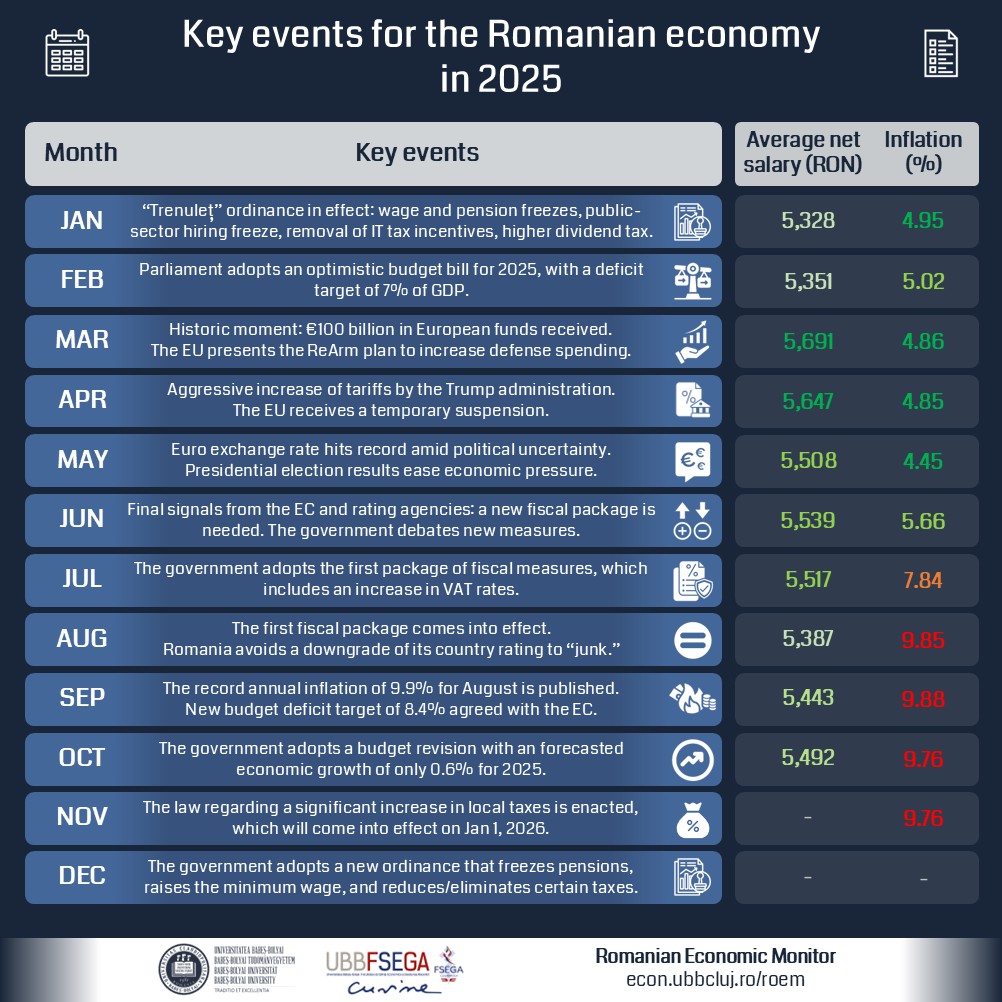
To provide a more detailed picture of Romania’s economic development in 2025, the Romanian Economic Monitor research team, in this article, reviews the most important economic events of each month of 2025.
January 2025
The year 2025 began with the entry into force of measures contained in the so-called “Train Ordinance,” adopted on the last working day of the previous year, aimed primarily at an immediate reduction in budgetary expenditures. The main measures involved freezing public sector salaries and pensions for the whole of 2025, blocking government hiring, increasing the tax on dividends, and eliminating the benefits previously enjoyed by employees in the IT, construction, agriculture, and food industries.
February
Given the unsustainable budget deficit, Parliament adopts the state budget law for 2025, built on an ambitious budget deficit target of 7% by the end of the year, based on fairly optimistic economic parameters: economic growth of 2.5% and average annual inflation of 4.4%. Although the targets were overly optimistic from the start, they at least signaled a firm commitment on the part of policymakers to restore fiscal balance in a complicated political and fiscal context.
March
Romania has reached an important milestone, passing the €100 billion threshold in terms of the total amount of non-reimbursable funds received from the EU budget. This historic moment shows that even in a difficult socio-economic situation at home, EU funds are an indispensable pillar of Romania’s economic development.
In the same month, the European Commission presents the ReArm Europe plan, which involves a significant increase in defense spending at the European level. Analysts argue that this plan may represent an opportunity for Romania to strengthen its heavy industry.
The most important transaction on the Romanian banking market, the merger of OTP Bank Romania with Banca Transilvania (BT), has been successfully completed, strengthening BT’s leading position on the domestic market.
April
The Trump administration is aggressively raising tariffs, a move unprecedented in US trade history over the past 100 years. After multiple negotiations and political pressure, the EU has secured a temporary suspension of tariffs, but these will continue to negatively affect the European economy, while also introducing a new factor of uncertainty in international trade.
May
Against a backdrop of general political and fiscal uncertainty, and following the shock caused by the first round of the presidential elections, which saw an extremist candidate reach the final, the euro exchange rate reached a historic low of 5.122 lei, exceeding the 5.1 lei threshold for the first time. The National Bank of Romania intervened several times to stabilize the exchange rate.
Nicușor Dan’s victory in the second round of the presidential elections has calmed spirits for the moment, the RON is appreciating strongly against the EUR, and the stock markets are recording a positive correction following the official announcement of the results. However, the problem of the budget deficit remains, and resolving it will be the most important task for the new government currently being formed.
June
Romania is receiving the latest signals from the European Commission and rating agencies: firm decisions to consolidate revenues and reduce budget expenditures can no longer be postponed, and the deficit must be brought back onto a sustainable path. Consequently, the government led by Ilie Bolojan is beginning debates on new fiscal measures.
July
The new law on the first package of fiscal measures is adopted at the end of July, introducing major fiscal changes, mainly aimed at bringing immediate additional revenue to the state budget. The most important measures include increasing the standard VAT rate from 19% to 21%, eliminating the reduced VAT rates of 5% and 9%, replaced by a single reduced rate of 11%, an increase in excise duties, the introduction of CASS for pensions over 3,000 lei, a surcharge on credit institutions and gambling, etc.
August
The first package of fiscal measures comes into force on August 1. These measures will prevent a public debt financing crisis in the short term and Romania’s downgrading to “junk” status. Although these measures represent an additional burden for the population and the business environment, they will bring an immediate surplus to the state budget. However, initial estimates show that these measures will be insufficient to achieve the target of a 3% budget deficit as a percentage of GDP. Thus, debates are underway regarding a second package of fiscal measures, aimed at correcting the inefficiencies of the public system and reducing unnecessary state budget expenditures, including the issue of special pensions.
Another major banking transaction is completed, the merger between UniCredit Bank and Alpha Bank Romania, which consolidates UniCredit’s position in the Romanian banking market.
September
The National Institute of Statistics publishes data on the annual inflation rate for the previous month, which is a surprising 9.9%. The general increase in prices comes after the VAT rate increase in August and the elimination of energy price caps starting in July.
The government agrees with the European Commission on a new budget deficit target of 8.4% of GDP for 2025, well above the initial target of 7%, given that the effect of fiscal measures is only reflected in the last 4-5 months of the year.
October
On the first day of the month, the government adopts a budget amendment that calculates economic growth of only 0.6% compared to 2.5%, the figure adopted in February in the state budget law. October is also the first month of 2025 in which the budget deficit shows signs of improvement compared to the previous year: the cumulative deficit for the first 10 months reaches 5.7%, 0.5% lower than in the same period of 2024.
November
As part of the second package of tax measures, Parliament is adopting a law on significant increases in certain local taxes, which will come into force on January 1, 2026. The increases mainly concern taxes on housing and cars. Additional taxes on packages ordered from online platforms outside the EU will also come into force at the beginning of 2026.
The government adopts the second budget amendment this year, with the target remaining unchanged at 8.4% of GDP, based on an estimated economic growth of 0.6% and an average inflation rate of 7.1%.
December
After several months of legal and political dispute, the government is assuming responsibility in Parliament for the second time for the bill on raising the retirement age and capping the amount of special pensions for magistrates.
Before Christmas, the government adopts a new “train ordinance” establishing, among other things, an increase in the minimum wage, a reduction in the minimum tax on turnover in 2026, with its definitive elimination starting in 2027, a flat rate of 1% for micro-enterprises, and the elimination of the so-called “pole tax.” The measures aim to correct some unnecessary fiscal anomalies and complexities from the past, with the intention of creating a more stable fiscal framework.